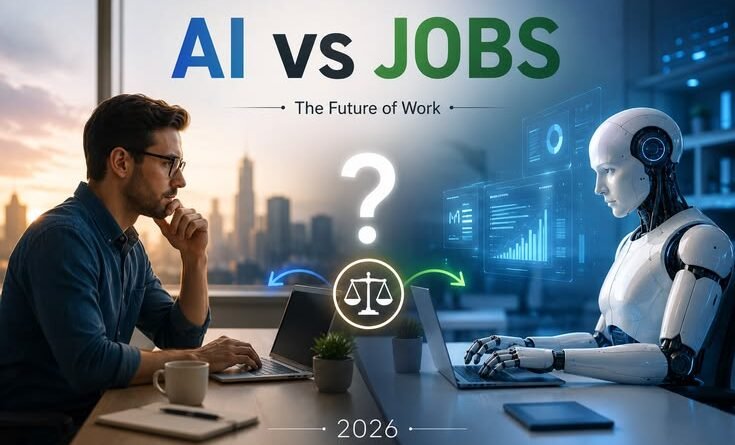
Is AI Really Taking Jobs? What the Data Actually Shows in 2026
Last year, a friend of mine — a mid-level content writer at a marketing agency — got a call from her manager. She half-expected a raise conversation. Instead, she was told that her team of six writers was being reduced to two, and AI tools would “handle the rest.” She wasn’t fired exactly — they kept her on as an “AI content strategist” at the same pay, but with triple the workload. She now spends her days editing AI-generated drafts instead of writing her own.
Was she replaced by AI? Kind of. Was her job eliminated? Not exactly.
That murky middle ground is where most of the real AI-and-jobs story actually lives in 2026 — and almost nobody is telling it accurately.
The Headlines Are Getting It Wrong (Both Sides)
Open any news feed and you’ll find two opposing narratives running on loop. On one side: “AI is coming for your job, millions will be unemployed, the robots are winning.” On the other: “Don’t worry, AI creates more jobs than it destroys, history proves it.”
Both camps are cherry-picking. And honestly, if you’re a working professional trying to figure out what this means for your career, neither framing is particularly useful.
So let’s get into what the actual data says.
What’s Really Happening to Existing Jobs
Here’s the number that surprised me most when I dug into the research: AI isn’t primarily eliminating existing jobs right now. It’s quietly suppressing the creation of new ones.
A Yale analysis found no clear upward trend in AI-task exposure among the unemployed — suggesting that while AI is clearly affecting hiring (fewer entry-level jobs being created), it has not yet produced a measurable wave of direct AI-attributable unemployment beyond the tech sector. AI appears to be suppressing hiring more than destroying existing jobs in the near term — a pattern consistent with employers integrating AI to avoid adding headcount rather than immediately firing existing workers.
Think about what that actually means. If you already have a job, you’re probably safer than the headlines suggest. But if you’re a fresh graduate trying to break into the workforce? You’re walking into a market where companies are posting fewer entry-level positions because AI is handling those tasks instead.
That’s a different kind of crisis — and it’s one that doesn’t make the front page as often.
Many early layoffs have hit routine and mid-level positions. Senior staff often keep their roles but may take on more work as AI handles junior tasks. In other words, companies are hiring more slowly where AI can do some of the work.
The Numbers Worth Actually Paying Attention To
Okay, let’s talk data. Because there’s a lot of it out there, and some of it gets wildly misrepresented.
Goldman Sachs models project that approximately 300 million full-time jobs worldwide will be affected by generative AI, with 6–7% of the US workforce — roughly 11 million workers — facing direct displacement risk. These figures measure exposure, not elimination.
That distinction — exposure versus elimination — is doing a lot of heavy lifting and most people skip right past it.
McKinsey estimated in late 2025 that today’s technology — what exists right now, not future iterations — could, in theory, automate approximately 57% of current U.S. work hours. That is not 57% of jobs being eliminated. It means that across the entire working population, just over half of the hours worked involve tasks that could be automated.
So when you see a stat like “AI could automate 57% of jobs,” what it really means is closer to: AI could handle about half the tasks people do across all jobs. That leaves the other half — the judgment calls, the relationship management, the creative direction, the crisis handling — still firmly in human territory.
The tech sector, to be fair, has taken a more visible hit. In the United States alone, 55,000 jobs were directly impacted by AI-driven automation in 2025, with continued disruptions accelerating into 2026. And in the first six months of 2025 alone, 77,999 tech job losses were directly attributed to AI. Those are real people with real disrupted lives, and it would be dishonest to wave that away.
But zoom out: the World Economic Forum’s Future of Jobs Report projects that by 2030, 92 million jobs will disappear but 170 million new roles will emerge, yielding a net gain of 78 million positions.
A net gain of 78 million jobs. That’s the headline that rarely gets the same panic treatment.
The Part Nobody Warned Us About: Career Compression
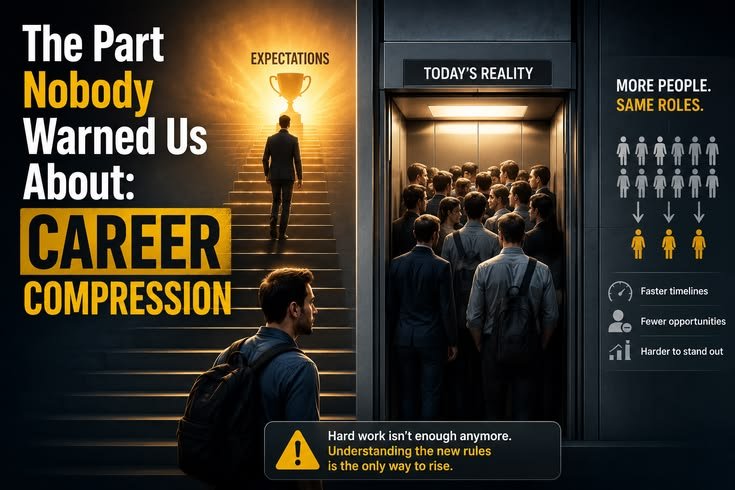
Here’s something I’ve noticed that the statistics don’t fully capture yet: it’s not just about job counts. It’s about career trajectories being flattened.
Think about the old path in fields like design, writing, law, or marketing. You’d start as a junior, do the grunt work, learn the craft, move up over five or six years, and eventually reach a senior or strategic role.
AI is compressing that ladder. The “grunt work” — first drafts, initial research, basic data analysis, boilerplate legal documents — is increasingly being done by tools like ChatGPT, Claude, Midjourney, or Copilot. Which means fewer entry-level positions exist to train the next generation of senior professionals.
Employment rates may remain stable while career mobility declines. The 2025–2030 period represents the critical transition window, and AI job displacement statistics are not a prophecy of mass unemployment — they are a warning about misalignment during rapid transition.
My friend, the writer I mentioned at the start? She still has a job. But she’s not developing her craft anymore. She’s editing outputs from a tool that doesn’t understand nuance, fixing its mistakes, and processing twice the volume for the same pay. That’s not displacement in the traditional sense. But it’s not good either.
The Jobs Actually Being Created
Now here’s where things get genuinely interesting — and where I think most of the doom-and-gloom coverage drops the ball.
AI/ML job postings surged 163% from 2024 to 2025, reaching 49,200 positions in the US alone. PwC’s 2025 analysis found that roles requiring AI skills carry a 56% wage premium over comparable non-AI positions, up from 25% just one year earlier.
Fifty-six percent. That’s not a small bonus. That’s the market telling you very loudly where it sees value.
AI Engineer roles grew 143.2% year over year. Prompt Engineer roles grew 135.8%, and AI Content Creator roles grew 134.5%. Job postings mentioning “agentic AI” grew by 985% between 2023 and 2024.
And it’s not just the highly technical roles. In 2025, healthcare was the single largest creator of AI jobs, generating more than 640,000 positions linked to automated diagnostics, predictive analytics, and virtual patient support.
LinkedIn data shows AI has already added 1.3 million new jobs, and four of LinkedIn’s top five fastest-growing positions are AI-related.
Entirely new categories of work are appearing too. Answer Engine Optimization (AEO) and Generative Engine Optimization (GEO) Specialists — roles focused on ensuring companies surface meaningfully in AI-generated responses — were virtually nonexistent before 2025, but hiring accelerated sharply in the latter half of that year and has continued into 2026.
This is classic economic disruption behavior. Electricity didn’t just replace gas lamp lighters — it created electricians, electrical engineers, appliance designers, and a whole ecosystem of industries that didn’t exist before. We’re watching the same movie, just at a much faster frame rate.
Which Jobs Are Actually at High Risk?
Let’s be direct about this. Not all jobs face equal exposure, and pretending otherwise doesn’t help anyone.
The highest-risk categories right now:
Routine cognitive work — data entry, basic coding, boilerplate writing, invoice processing, appointment scheduling. If your job is primarily defined by following a predictable process with structured inputs, it’s exposed.
Entry-level knowledge work — junior analysts, first-year associates, junior copywriters, basic customer support. Not because the roles are gone, but because companies are hiring fewer people for them.
Manufacturing — MIT and Boston University research indicates that AI-driven robotics will have replaced approximately 2 million manufacturing workers globally by 2026, focusing specifically on AI-driven robotics — physical automation systems guided by machine learning, computer vision, and AI planning algorithms.
Approximately 3.9% of U.S. workers — roughly 5 to 6 million people — sit at the intersection of high AI exposure and low adaptive capacity, meaning they work in automatable roles and have fewer resources to pivot. That’s the group that needs the most support — and the group that policy discussions most often abstract away into statistics.
What the Data Suggests You Should Actually Do
I’m not going to pretend there’s a magic five-step plan here. But based on what the research actually shows, a few patterns are clear:
Develop AI fluency, not just AI awareness. There’s a gap between people who have “heard of” tools like Claude, Copilot, or Gemini and people who use them daily in their workflows. The latter group is commanding that 56% wage premium. The former is watching their negotiating power erode.
Move upstream in your field. Whatever you do, identify where the judgment, strategy, and relationship-building live. Those are the parts AI can assist with but can’t own. Push yourself toward those functions.
Don’t treat “my job is safe” as a destination. The Federal Reserve Bank of Dallas found that in jobs with significant AI exposure, wages were not uniformly declining, suggesting that for many workers, AI is currently augmenting rather than replacing their output. “Augmenting” is good — but it requires you to actually work with the tools rather than against them.
Watch the adjacent opportunities. AI trainers, ethicists, and explainability experts are emerging roles created directly by AI adoption. AI support roles like prompt engineers and AI operations specialists are new job types with rapid growth. Some of the fastest-growing paths don’t require a computer science degree — they require deep domain expertise in another field plus AI literacy.
The Mistake Most People Are Making
The biggest error I see — especially online — is people treating this as a binary. Either “AI will take all our jobs” or “AI will create more jobs, stop panicking.”
Neither response is adequate.
The real dynamic is a redistribution of labor — and redistribution always creates winners and losers, usually along existing lines of access, education, and economic cushion. People with resources to reskill, access to good information, and jobs that sit higher on the cognitive ladder will likely land fine. People without those advantages face a much harder transition, even if the overall job count goes up.
The Information Technology and Innovation Foundation’s December 2025 analysis found that, at least through 2024, AI’s job creation effects were outpacing its displacement effects — primarily because the AI boom generated significant employment in data center construction, hardware, and AI development itself.
That’s reassuring at a macro level. It’s less reassuring if you’re a 52-year-old paralegal in a mid-sized city who isn’t positioned to pivot into data center construction.
Where This Is All Heading
The honest answer is: we don’t fully know yet. The scale of this transition is genuinely unprecedented, and anyone who tells you they have a precise map of where the labor market lands in 2030 is guessing.
What we do know is that the 2026–2028 period is projected to be when career transitions spike and displacement peaks, before a new equilibrium forms with fewer but more leveraged roles by 2029–2035.
That means we’re right in the middle of it. The friction is real. The discomfort is real. My friend editing AI content instead of writing her own work — that’s real. So are the 1.3 million new jobs LinkedIn says AI has already created.
Both things are true at once. And sitting with that complexity — rather than fleeing to whichever headline feels more emotionally satisfying — is probably the most useful thing any of us can do right now.
The question was never really “Is AI taking jobs?” It’s always been “Who is positioned to navigate what comes next?” Start answering that one for yourself, and the broader statistics become a lot less scary.